
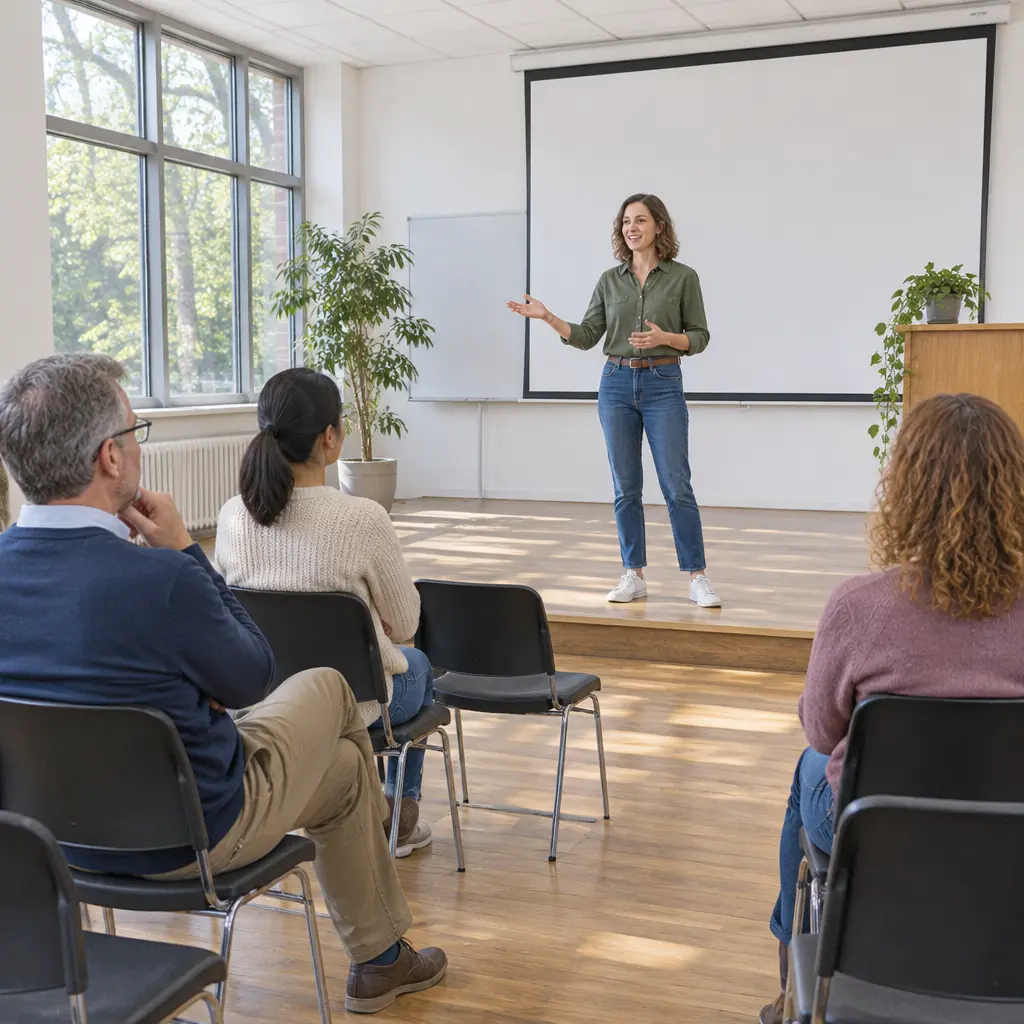
Learning to perform is the deliberate practice of presenting an action, role, or idea for an audience, whether onstage, in a classroom, or in everyday life. It changes how we think by making us monitor ourselves from the outside, anticipate other people’s responses, and coordinate attention, emotion, memory, and movement. Research on theatre education, perspective-taking, and social cognition supports these links, although effects depend on the type and duration of training. The result is not simply greater confidence: performance can reshape how people interpret situations, manage attention, understand others, and learn from feedback.
Performance Practice and the Thinking Process
Performance practice is structured preparation for communicating or enacting something before observers. It includes theatrical acting, public speaking, music, dance, role-play, and other activities in which a person makes choices while being seen or heard. Psychologist Erving Goffman’s account of social interaction describes people as managing impressions in everyday life; formal performance makes that normally implicit process more visible and deliberate.
Learning to perform recruits several kinds of thinking at once. A performer must attend to the task, remember material, interpret an audience, regulate arousal, and adjust in response to cues. These demands can strengthen useful habits, but they can also increase self-consciousness or cognitive load, especially for beginners. The central distinction is between practice that turns attention into a flexible tool and pressure that traps attention in fear of evaluation.
Attention and Self-Monitoring
Self-monitoring is the process of noticing and adjusting one’s behavior in relation to a goal or audience. Performers learn to direct attention among internal cues—such as breath, timing, or posture—and external cues, such as a partner’s expression or a change in the room. With repetition, some technical actions become more automatic, leaving more mental capacity for interpretation and interaction.
This change is not guaranteed to improve concentration in every situation. In “The Choking Game: Individual Differences in Susceptibility to Performance Pressure,” psychologists Sian Beilock and Thomas Carr describe how heightened self-focus can disrupt skills that normally run smoothly, particularly when people consciously control well-practiced actions. Performance training is therefore most useful when it teaches performers what to monitor and when to trust practiced routines.
Memory, Rehearsal, and Cognitive Load
Rehearsal is repeated, goal-directed practice that prepares a sequence for reliable execution. Actors memorize lines and cues; musicians coordinate notes with timing; speakers organize arguments into retrievable sections. These activities rely on working memory—the limited mental capacity used to hold and manipulate information—and on retrieval practice, which strengthens access by requiring learners to recall material rather than merely reread it.
Performance can make memory more robust by linking words or actions to movement, emotion, spatial position, and social cues. It can also expose overload: forgetting a line while tracking a partner and managing nerves illustrates how competing demands consume attention. In practice, breaking material into manageable units, repeating it under varied conditions, and gradually adding audience-like pressure can help learners transfer rehearsal into live situations.
Perspective-Taking and Social Cognition Through Performance
Social cognition is the set of mental processes used to perceive, interpret, and respond to other people. Performance makes those processes part of the task: an actor must infer what a character knows, a speaker must estimate what listeners understand, and an ensemble member must coordinate with others. These demands connect performance learning with perspective-taking, empathy, and collaborative attention, while leaving room for important differences among individuals and training settings.
Role-Play and Perspective-Taking
Perspective-taking means considering a situation from another person’s point of view. In role-play, learners temporarily work with a character’s goals, knowledge, and circumstances. This does not require believing that the role represents every real person in a group; rather, it offers a structured way to test interpretations, notice assumptions, and consider how different motives could shape behavior.
A 2018 study by researchers led by E. L. Goldstein, published in the journal Applied Developmental Science, examined a year-long classroom drama program and reported improvements in children’s theory of mind—the ability to reason about other people’s mental states—compared with a control activity. The result supports the potential of sustained drama practice, not the claim that a single acting exercise will reliably produce the same effects for everyone.
Empathy, Emotional Interpretation, and Collaboration
Empathy involves recognizing or responding to another person’s emotional state; it is related to, but not identical with, perspective-taking. Performers practice reading voice, gesture, timing, and facial expression, then coordinate their own responses. Ensemble work adds shared attention: participants must listen, respond, and adapt rather than simply deliver a prepared contribution in isolation.
A 2020 meta-analysis by researchers led by L. Goldstein and colleagues, published in Review of Educational Research, synthesized studies of drama-based instruction and found positive average effects across several educational outcomes, including academic and social-emotional measures. As with any meta-analysis, results combine programs that differ in design, duration, and measurement. The practical lesson is to treat drama as a promising learning method whose impact depends on facilitation, opportunity to reflect, and the outcomes being assessed.
Emotional Regulation and Learning From an Audience
Emotional regulation is the ability to influence how emotions arise, how strongly they are experienced, and how they are expressed. Performing provides repeated encounters with anticipation, uncertainty, and evaluation. Over time, supported practice can help learners recognize arousal and choose useful responses; it does not mean eliminating nerves or treating all anxiety as beneficial.
Managing Arousal and Performance Anxiety
Performance anxiety is distress connected with the possibility of being judged while performing. A performer may experience physical arousal—such as a faster heartbeat—as either a warning sign or energy that can be directed toward the task. Preparation, breathing, familiar routines, and gradual exposure to audience conditions can make the experience more manageable, but persistent or severe anxiety may require support beyond practice alone.
The American Psychological Association describes stress as a response to demands that exceed, or seem to exceed, a person’s resources. That framing helps explain why the same audience can feel motivating to one learner and overwhelming to another: perceived control, preparation, prior experience, and stakes all matter. Effective instruction therefore combines challenge with psychological safety rather than using humiliation or surprise as supposed shortcuts to resilience.
Feedback, Reflection, and Adaptation
Feedback is information about performance that can guide a next attempt. Audience reactions, a teacher’s observations, video review, and peer comments each reveal different features of a performance. Reflection turns that information into a plan: learners identify what worked, what did not, and which specific change they will test next.
The National Academies’ report How People Learn II emphasizes the importance of prior knowledge, context, motivation, and feedback in learning. Applied to performance, this means critique is most useful when it is specific, timely, and connected to an achievable next step. “Pause before the key point” gives a learner something to try; “be more charismatic” offers a vague judgment with little guidance for improvement.
Performance Learning Across Settings
The mental effects of performance practice depend partly on its setting and purpose. Theatre, presentations, music, and simulation share public or social demands, but each trains different combinations of physical coordination, interpretation, memory, and communication. Looking across settings helps clarify which lessons transfer and which remain specific to the practiced activity.
Classroom Drama and Academic Learning
Classroom drama uses enactment, role-play, or performance to explore curriculum. A history lesson might ask students to represent conflicting viewpoints, while a language lesson might use dialogue to practice speaking in context. The method can make abstract material concrete and create reasons to use knowledge, but it works best when performance is tied to clear learning goals and followed by discussion that distinguishes evidence from invention.
The Education Endowment Foundation’s Teaching and Learning Toolkit summarizes evidence on arts participation and educational outcomes while cautioning that impact varies by approach and implementation. This is a useful reminder that simply adding a performance does not guarantee learning gains. Teachers need to assess both the artistic process and the underlying knowledge or skills the activity is meant to develop.
Public Speaking and Professional Simulation
Public speaking and professional simulation train people to communicate under observation. Students may rehearse presentations; health professionals may use simulated patients; organizations may practice difficult conversations through role-play. These settings let learners test decisions in a lower-risk environment before applying them in consequential situations.
Simulation-based education is particularly valuable when it pairs realistic practice with structured debriefing. The Society for Simulation in Healthcare identifies debriefing as a core element of simulation, because learners need to examine decisions and outcomes rather than merely repeat an exercise. The same principle applies to a presentation or audition: performance becomes a learning tool when the learner can interpret the experience and deliberately revise the next attempt.
Conclusion: Performance Practice as a Way of Thinking
Learning to perform changes thinking by training attention and self-monitoring, linking rehearsal with memory, inviting perspective-taking, and creating practice in emotional regulation and feedback. Research on classroom drama and drama-based instruction offers evidence of potential social and educational benefits, while cognitive research also warns that excessive self-focus can interfere with skilled action. The broader implication is that performance is not only a product shown to an audience; it is a process for noticing, interpreting, adapting, and learning.
To apply these ideas, choose a manageable performance task, rehearse it in stages, seek specific feedback, and reflect on one change for the next attempt. Educators and trainers can make the process more effective by combining meaningful challenge with clear goals and a supportive environment. For further reading, consult the National Academies’ How People Learn II and research reviews on drama-based education.
Sources: Goldstein, E. L., et al., “The Effects of a Classroom Drama Program on Children’s Theory of Mind,” Applied Developmental Science, 2018, https://doi.org/10.1080/10888691.2016.1221501; Goldstein, L., et al., “Drama-Based Pedagogy and Student Outcomes: A Meta-Analysis,” Review of Educational Research, 2020, https://doi.org/10.3102/0034654320933547; Beilock, S. L., and Carr, T. H., “The Choking Game: Individual Differences in Susceptibility to Performance Pressure,” Personality and Social Psychology Bulletin, 2001, https://doi.org/10.1177/0146167201277002; National Academies of Sciences, Engineering, and Medicine, How People Learn II: Learners, Contexts, and Cultures, 2018, https://doi.org/10.17226/24783; American Psychological Association, “Stress,” https://www.apa.org/topics/stress; Education Endowment Foundation, “Arts Participation,” Teaching and Learning Toolkit, https://educationendowmentfoundation.org.uk/education-evidence/teaching-learning-toolkit/arts-participation; Society for Simulation in Healthcare, “Healthcare Simulation Dictionary,” https://www.ssih.org/dictionary.