
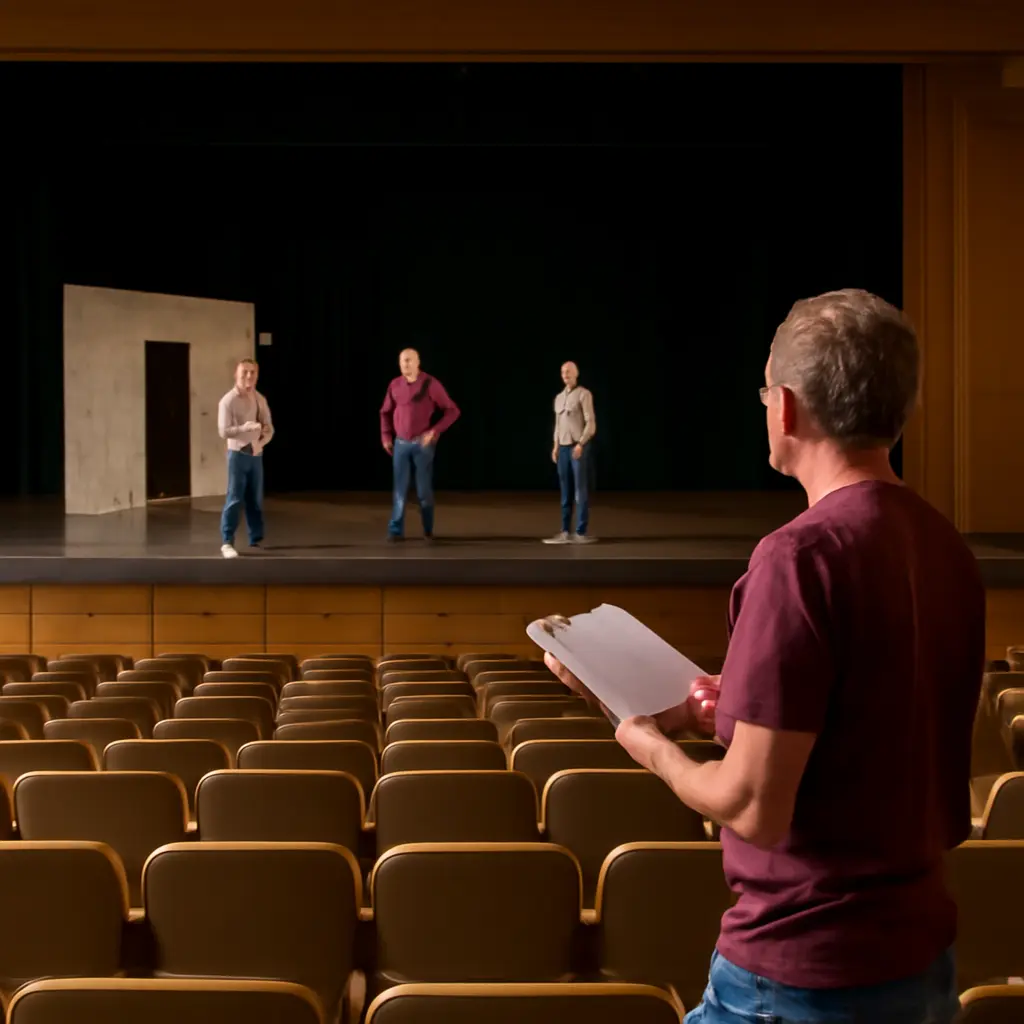
Watching a play in performance gives student playwrights a practical way to study dramatic structure: they can see how scenes, pauses, entrances, and audience reactions work in real time. Structure is the arrangement of events and dramatic elements that shapes an audience’s experience, not merely a formula on the page. By observing productions, reading scripts alongside performance, and reflecting on choices made by actors and directors, emerging writers can connect techniques such as pacing, conflict, and scene transitions to their effects on viewers. This article explains what production-based learning involves, which structural features students can track, and how to turn observation into stronger writing, drawing on theater education research and established dramatic frameworks.
Production-Based Learning and Play Structure
Production-based learning is an approach in which students develop knowledge by observing or participating in the making and performance of a work. For playwrights, watching a live production supplies evidence that a script alone cannot: the timing of a laugh, the length of a silence, the audience’s attention during a transition, and the physical clarity of an entrance. The National Core Arts Standards describe creating, performing, responding, and connecting as interrelated artistic processes. Watching a production is especially useful for “responding”—analyzing and interpreting artistic choices—and “connecting,” relating those choices to context and experience.
The practical value is not that every play follows one blueprint. Rather, performance lets students test how different structures organize attention and expectation. A student can compare a tightly linear story with a fragmented or episodic one, then ask what each arrangement makes the audience notice, anticipate, or feel. The bridge from observation to craft is deliberate: identify a choice, describe its effect, and consider how a similar choice might serve a different story.
Plot structure as visible cause and effect
Plot structure is the arrangement of actions and consequences through which a dramatic situation changes. Aristotle’s Poetics describes plot as the organization of incidents and emphasizes that events should form a coherent whole. In a performance, students can watch how a character’s decision produces a new obstacle, how that obstacle raises the stakes, and whether later events feel earned. This makes abstract ideas such as exposition, turning point, climax, and resolution observable rather than purely theoretical.
A useful viewing question is: “What changes because this scene happened?” If the answer is unclear, the scene may be establishing atmosphere, revealing character, or developing a theme—but the writer should understand its function. Aristotle’s framework is influential, not universal; contemporary, devised, and non-Western theater may use different patterns of sequence and closure.
Scene and act structure as units of attention
Scene structure organizes a play into smaller units, often marked by a change in time, location, characters, or dramatic objective. Students can note when a scene begins late, ends early, or shifts focus, then observe whether those choices maintain momentum. The performance also reveals practical dimensions of structure: a blackout can create a strong break, while a continuous transition can make events feel inevitable or urgent.
Act divisions can shape anticipation and provide larger pauses in a theatrical evening, but conventions vary by period, genre, and venue. Rather than assuming a fixed number of acts, student playwrights can track how a production groups scenes and where it places its major reversals. The Royal Shakespeare Company’s educational materials, for example, encourage close attention to how dramatic language and performance choices influence meaning—a useful reminder that structure is experienced through both text and staging.
Performance Reveals How Dramatic Structure Works
The script proposes a sequence; the production makes that sequence happen in space and time. Actors, directors, designers, and audiences all contribute to the result. This is why watching real productions is not simply a way to collect plot templates. It helps student playwrights understand how structure is communicated through pace, embodiment, sound, and visual composition—and how a written choice can land differently once performed.
Pacing, silence, and audience response
Pacing is the perceived speed and rhythm of dramatic action. It depends on more than the number of words: an actor’s pause, a repeated gesture, a quick exchange, or an extended transition can change the tempo. Students can observe where an audience laughs, becomes still, or appears restless, while remembering that one audience’s response is evidence of that performance, not a universal measure of success.
To make observation useful, record the moment and its context: what was revealed, withheld, or changed immediately before the response? A pause after a revelation may give the audience time to absorb it; a pause before an answer may build suspense. This kind of note connects a structural decision to its possible effect without treating audience reaction as a simple score.
Character objectives and dramatic conflict
Dramatic conflict arises when characters pursue incompatible goals or encounter forces that obstruct what they want. A production makes those objectives legible through behavior: where a character looks, when they interrupt, what they avoid saying, and how they respond when another person changes the situation. Student playwrights can map each scene by asking who wants what, what stands in the way, and what changes by the end.
This method also helps distinguish a busy scene from a dramatic one. A scene can contain movement and lively dialogue yet remain structurally static if no objective, relationship, or understanding shifts. Conversely, a quiet exchange may alter the audience’s interpretation of a character and redirect the whole play.
Transitions, staging, and theatrical storytelling
A transition is the movement between scenes or dramatic states. Productions may use scenery, lighting, sound, movement, or deliberate stillness to signal that shift. Watching how a company handles transitions teaches student playwrights that structure can be communicated visually and aurally, not only through dialogue or scene headings.
For example, a production that changes location in full view may preserve continuity and emphasize theatrical artifice. A blackout may instead create a sharper break. The choice affects the audience’s sense of time, place, and momentum, so playwrights should consider what a transition contributes before specifying elaborate staging that may not be essential to the story.
Ways Students Can Study Productions and Apply What They See
Observation becomes a writing skill when students move beyond “I liked it” or “it was confusing” and support a response with evidence. A simple process—prepare, watch, analyze, and experiment—helps turn a theater visit into a repeatable craft practice. It also encourages students to separate the playwright’s structural choices from the director’s and performers’ interpretations.
Use a focused observation guide
Before attending, students can read the script if available and select one question to investigate, such as how a turning point is staged or how a recurring image develops. During the performance, they can make brief notes without trying to transcribe every moment. Afterward, they can reconstruct the sequence and identify where their attention changed.
- What does the central character want at the start, and what interrupts that pursuit?
- Which scene changes the stakes, relationship, or audience’s understanding?
- Where does the performance speed up or slow down, and what might explain the shift?
- How do entrances, exits, sound, lighting, and transitions clarify the structure?
- What remains unresolved at the end, and does that feel intentional?
These questions produce more useful evidence than a general judgment. Students should also note uncertainty: a confusing moment may result from the script, the staging, or their own unfamiliarity with the play’s context.
Compare script, rehearsal, and performance
When students can access a script and a production, comparison reveals how structure survives interpretation. A director may compress a pause, combine locations, or emphasize a secondary character. If the script is unavailable, students can still reconstruct a scene map from memory and compare their impressions with reviews, production notes, or a later reading.
Theater education organizations such as the Educational Theatre Association support learning through varied forms of participation, including performance, production, and response. These activities help students recognize that playwrighting is part of a collaborative art form: an audience experiences a complete event shaped by many contributors, while the writer remains responsible for giving that event a playable dramatic foundation.
Turn observation into a controlled writing experiment
A writing experiment applies one observed technique to original material without copying the play. A student might rewrite a scene so that its conflict appears earlier, test whether a transition works without a blackout, or place a revelation at a different point. Comparing drafts helps reveal how one structural change affects pace, clarity, and emotional emphasis.
- Choose one structural feature observed in the production.
- Describe the feature’s apparent function and the evidence for that interpretation.
- Apply it to a short original scene while keeping the characters and situation distinct.
- Read the scene aloud or stage it, then note what changed for listeners or performers.
- Revise based on the result rather than assuming the borrowed technique will always work.
This process reflects a broader principle of arts learning: making, performing, and responding reinforce one another. It also protects against imitation by asking students to transfer a structural principle—such as delayed information or escalating obstacles—into their own dramatic world.
Conclusion: Production Observation Builds Structural Judgment
Watching real productions helps student playwrights understand plot structure as cause and effect, scene structure as an organization of attention, and performance choices as part of how a dramatic design reaches an audience. By tracking pacing, objectives, conflict, transitions, and audience response, students gain practical evidence that can guide their own revisions. The most productive next step is to attend a performance with one focused question, make a scene map afterward, and test one observed technique in an original scene. Repeating that cycle builds structural judgment while preserving the playwright’s freedom to invent forms that serve the story.
Sources: National Coalition for Core Arts Standards, National Core Arts Standards, https://www.nationalartsstandards.org/; Aristotle, Poetics, translated by S. H. Butcher, Internet Classics Archive, https://classics.mit.edu/Aristotle/poetics.html; Royal Shakespeare Company, Teaching Resources, https://www.rsc.org.uk/education/teaching-resources; Educational Theatre Association, Theatre Education Resources, https://schooltheatre.org/