
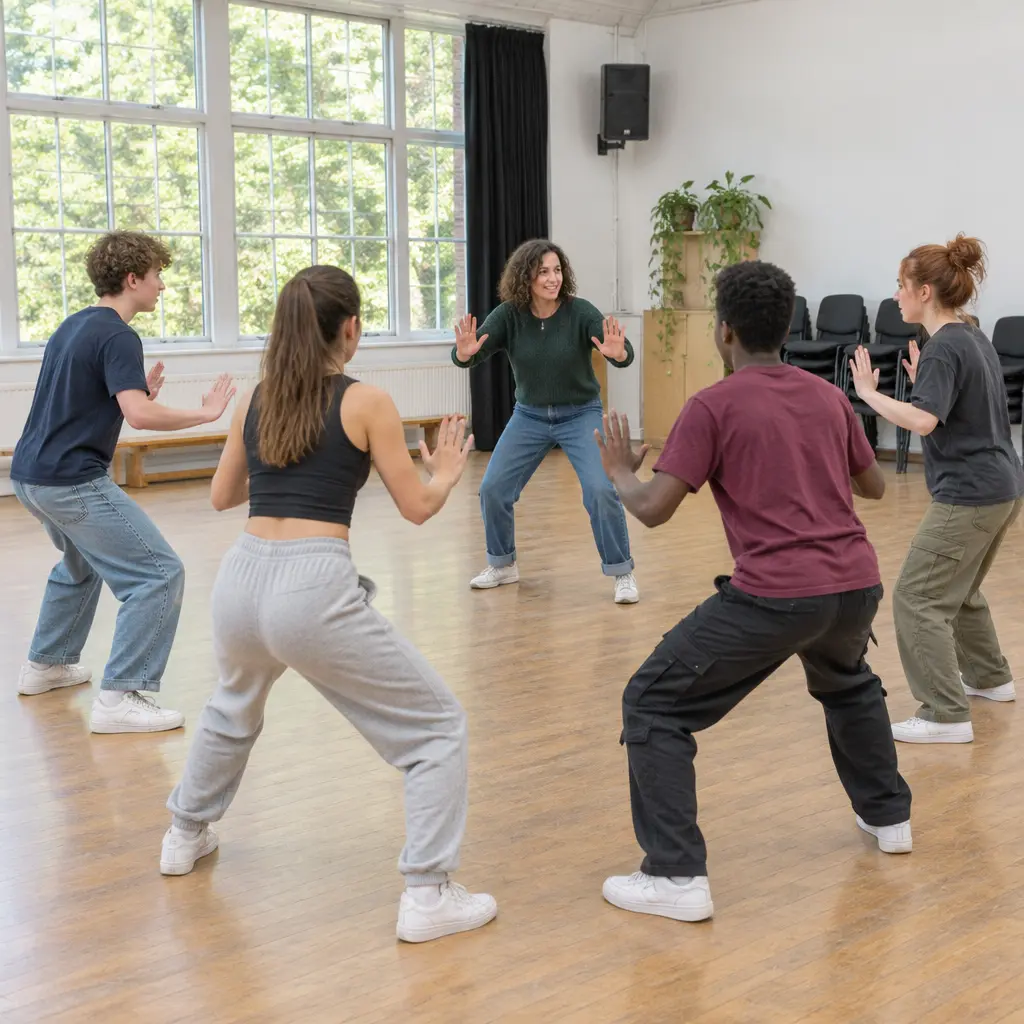
Youth theatre development is the use of theatrical activities to support young people’s learning, expression, and social development. When confidence-building is the priority, programmes use drama games, improvisation, ensemble work, and performance as opportunities to practise communication, collaboration, and self-belief—not as a pipeline for professional acting. This distinction matters: UNICEF reports that adolescence is a period of rapid physical, cognitive, and psychosocial development, while the World Health Organization estimates that one in seven 10–19-year-olds experiences a mental health condition. Theatre is not a substitute for mental-health care, but thoughtfully designed youth programmes can offer an inclusive setting for participation, agency, and connection.
Youth Theatre Development Prioritizes Confidence Building Over Professional Acting Training
Confidence-building defines youth theatre development
Youth theatre development is an educational and participatory approach in which theatre activities are designed around young people’s growth, rather than primarily around producing technically polished actors. The National Association of Teachers of Singing’s educational guidance and the International Drama/Theatre and Education Association’s practice both reflect a wider distinction between theatre as an art form and drama as a learning process: young people can develop through making and reflecting on drama, whether or not they pursue performance professionally.
In a confidence-centred programme, “confidence” is not treated as a fixed personality trait or a promise that every participant will enjoy being onstage. It is a set of capacities that can be practised: speaking up, making choices, managing nerves, listening to others, taking creative risks, and recovering when something goes wrong. A young person may demonstrate these capacities by performing a role, contributing backstage, writing dialogue, or helping shape an ensemble scene.
This emphasis is relevant to young people’s wellbeing and education. The World Health Organization identifies supportive environments and social and emotional skills as important to adolescent mental health. In the United States, the National Endowment for the Arts’ research on arts education has examined associations between sustained arts participation and academic and social outcomes, particularly for students from lower-income backgrounds. Such findings support the value of access to arts learning, but they do not prove that a theatre class alone causes greater confidence or improves mental health.
Confidence as a teachable outcome
Confidence in youth theatre means a growing willingness to participate, express an idea, make a creative decision, and engage with others. It does not require extroversion, flawless performance, or the absence of anxiety. Facilitators can make the goal observable by tracking behaviours such as volunteering an idea, speaking audibly when ready, giving constructive feedback, or trying a task after an initial hesitation.
The Collaborative for Academic, Social, and Emotional Learning (CASEL) describes social and emotional learning through competencies including self-awareness, self-management, social awareness, relationship skills, and responsible decision-making. These competencies provide a useful framework for theatre educators: a warm-up can support self-management, ensemble improvisation can practise relationship skills, and devising a scene can require shared decision-making. They are related outcomes, not interchangeable measures; a participant’s progress should be assessed through observation and reflection rather than assumed from attendance or applause.
Development before audition-level technique
Professional acting training typically prioritizes increasingly specialised craft, such as voice production, movement, text analysis, audition technique, and performance consistency. Youth development may introduce some of these skills, but it places them within an age-appropriate, low-pressure learning environment. The distinction is about priority, not opposition: technique can help a young person communicate an idea, while the programme’s central measure of success remains learning, participation, and creative growth.
A development-first approach also recognises that children and adolescents differ in readiness, disability, language, culture, and comfort with visibility. Rather than treating casting or memorisation as the only evidence of achievement, a programme can offer meaningful roles in writing, design, stage management, music, movement, and production. This widens the definition of theatrical contribution and can reduce pressure on young people who are still building confidence.
Participatory methods turn confidence goals into practice
The confidence-centred objective becomes practical through methods that give young people repeated, manageable opportunities to act, reflect, and collaborate. Drama games, improvisation, ensemble creation, and optional performance are related forms, but they offer different levels of structure and public exposure. A balanced programme moves between them instead of assuming that a final production is the only meaningful outcome.
Drama games and low-stakes participation
Drama games are short, structured activities that use movement, voice, attention, and imagination to build group familiarity and creative responsiveness. Examples include mirroring, passing a rhythm, creating a shared tableau, or inventing a character from an object. Because the activities are brief and usually have no single “correct” artistic result, participants can experiment without the pressure of carrying a lead role.
A facilitator can make these exercises more inclusive by offering a choice to speak, gesture, observe, or participate with a partner, and by explaining that opting for a quieter role is still participation. This is especially important when a group includes young people who are new to theatre, use assistive communication, or feel uneasy with unexpected touch or loud activity. The aim is not to remove challenge, but to scale it so that challenge remains voluntary, safe, and achievable.
Improvisation and creative risk-taking
Improvisation is the creation of unscripted action or dialogue in response to a prompt, partner, or imagined situation. It can help young people practise listening, adaptability, and accepting another person’s contribution. Simple formats—such as building a story one sentence at a time—give every participant a clear turn and make collaboration more important than producing a clever performance.
The educational value depends on how the activity is facilitated. If mistakes are mocked or participants are forced into emotionally exposing scenes, improvisation can increase rather than reduce anxiety. Clear boundaries, opt-in prompts, supportive feedback, and permission to pause help establish the psychological safety required for genuine creative risk-taking. These principles align with CASEL’s emphasis on supportive relationships and social-emotional skill development.
Ensemble devising and shared ownership
Ensemble devising is the collaborative creation of a performance from participants’ ideas, images, movement, writing, or improvisations. Instead of beginning with a fixed script and assigning every role, a facilitator may invite the group to explore a theme, select material, and shape scenes together. This approach gives young people concrete opportunities to negotiate, make decisions, and see their contributions reflected in a shared work.
Shared ownership does not mean that adults abandon responsibility. The facilitator remains accountable for safeguarding, age-appropriate content, accessibility, and equitable participation. They can prevent a few confident voices from dominating by using small-group tasks, anonymous idea collection, rotating responsibilities, and structured turn-taking. These practices make “ensemble” an observable working method rather than just a label.
Performance as an option, not the sole measure
A showcase or public performance can give participants a goal, a shared deadline, and an opportunity to celebrate their work. It should not be treated as the only proof that a programme succeeded. For some young people, performing before an audience is a meaningful confidence milestone; for others, contributing backstage or choosing not to perform may represent equally important growth.
Programmes can make performance more developmentally appropriate by offering different levels of visibility: an informal sharing for families, a recorded scene shown only to the group, a design exhibition, or a fully staged production. Participants should know what will be shared, with whom, and whether recording or photography is involved. This lets public presentation support agency rather than become a test imposed on every young person.
Inclusive programme design supports confidence and belonging
Confidence-building depends not only on the exercises used, but also on whether young people feel respected, represented, and able to participate. A programme that celebrates bravery while ignoring access barriers may privilege participants who already feel comfortable speaking, moving, or performing. Inclusion therefore needs to be built into recruitment, facilitation, rehearsal conditions, and evaluation.
Psychological safety, choice, and safeguarding
Psychological safety in a youth theatre setting means that participants can ask questions, make mistakes, set boundaries, and offer ideas without humiliation or coercion. It is supported by predictable routines, respectful language, clear group agreements, and adult responses that take concerns seriously. It does not mean that every activity feels easy; it means young people are not pressured to disclose personal experiences or perform beyond agreed boundaries.
Safeguarding procedures should be specific to the organisation and local law. They commonly include trained and vetted adults where required, clear reporting routes, appropriate supervision, consent processes, and policies for photography, transport, and digital communication. The National Society for the Prevention of Cruelty to Children (NSPCC) emphasises that safeguarding is an ongoing organisational responsibility, not a one-time form. A confidence-led programme must therefore pair encouragement with reliable protection.
Access, representation, and multiple ways to contribute
Inclusive youth theatre makes participation possible for young people with different abilities, languages, cultural backgrounds, economic circumstances, and communication styles. Practical steps can include step-free venues, sensory breaks, scripts in accessible formats, clear schedules, financial assistance, and roles that do not require public speaking. The National Endowment for the Arts has repeatedly identified unequal access to arts education as an important concern, making outreach and affordability central to programme design rather than optional extras.
Representation also affects whether young people can imagine themselves as makers of theatre. Facilitators can broaden whose stories appear by inviting participants to choose themes, use contemporary and culturally varied material, and question stereotypes in scripts. This should be done with care: young people should not be expected to speak for an entire identity group or disclose personal histories. Choice, consultation, and respect for privacy help build belonging without turning identity into an assignment.
Facilitator practice and supportive feedback
A youth theatre facilitator is responsible for guiding artistic activity while supporting learning and group wellbeing. This requires more than performance expertise: facilitators need to explain tasks clearly, notice who is being heard, adapt exercises, set boundaries, and respond constructively to conflict. Professional development in child development, inclusion, safeguarding, and trauma-aware practice can strengthen this work, while recognising that theatre facilitators are not automatically counsellors or mental-health clinicians.
Feedback should describe a participant’s choices and effort rather than rank their talent or personality. “You waited for your partner’s cue and changed your movement in response” gives actionable information; “You are a natural star” may praise a fixed identity and leave other participants feeling less valued. Specific feedback helps young people identify skills they can repeat and develops a group culture in which progress matters more than comparison.
Evaluation should measure growth, not casting success
A confidence-centred programme needs evaluation that matches its stated purpose. Ticket sales, competition results, and casting outcomes may describe a production, but they do not show whether participants felt included, practised new skills, or gained a greater sense of agency. Evaluation is strongest when it combines young people’s own reflections with facilitator observations and programme-level participation data.
Practical indicators of participant development
Useful indicators can include a participant’s willingness to contribute an idea, ability to work with peers, comfort trying an unfamiliar task, or readiness to ask for support. These should be recorded sensitively and interpreted in context: quietness is not necessarily low confidence, and a young person’s progress may be visible in attentive listening, technical work, or a deliberate choice to set a boundary. Private reflections, small-group check-ins, and end-of-session feedback can give participants a voice in assessing their experience.
For programme-level reporting, organisers can track attendance and retention, access to subsidised places, the range of participant roles, and whether young people report feeling respected and able to contribute. The National Endowment for the Arts’ arts-education research illustrates the value of examining participation and outcomes systematically, but local programmes should avoid claiming causal effects from small samples or self-reported satisfaction alone. Clear evaluation makes it easier to improve the programme without overstating what theatre can do.
A simple confidence-centred session structure
A consistent structure can help participants know what to expect and see their development over time. A 60–90-minute session might begin with a check-in, move into a low-stakes warm-up, introduce a focused creative task, allow time for group-making, and close with reflection. The exact duration should fit the participants’ ages, access needs, and setting.
- Welcome participants and review the group’s choices, boundaries, and activity plan.
- Use a brief warm-up that allows different levels of movement and verbal participation.
- Introduce one creative objective, such as listening, making a clear offer, or building a scene together.
- Work in pairs or small groups before inviting optional sharing with the whole group.
- Close with reflection: what did participants try, what supported collaboration, and what would they like to change next time?
Conclusion: youth theatre development values growth over polish
Youth theatre development prioritizing confidence building treats theatre as a space to practise expression, creative risk-taking, collaboration, and agency—not simply a route to professional acting. Drama games offer low-stakes entry points; improvisation and ensemble devising turn participation into shared creative work; optional performance can celebrate progress without defining it. Inclusive access, safeguarding, supportive facilitation, and evaluation centred on growth are essential to making those benefits credible and equitable.
The wider implication is that youth theatre can welcome young people who may never seek an acting career while still taking artistic work seriously. Schools, community organisations, and theatre companies can strengthen this approach by consulting young people, training facilitators, reducing access barriers, and assessing outcomes honestly. For further reading, explore the World Health Organization’s adolescent mental-health resources, CASEL’s social and emotional learning framework, and the National Endowment for the Arts’ research on arts education.
Sources: World Health Organization, “Adolescent mental health,” https://www.who.int/news-room/fact-sheets/detail/adolescent-mental-health; UNICEF, “Adolescent development and participation,” https://www.unicef.org/adolescence; Collaborative for Academic, Social, and Emotional Learning (CASEL), “What Is the CASEL Framework?,” https://casel.org/fundamentals-of-sel/what-is-the-casel-framework/; National Endowment for the Arts, “Arts Education,” https://www.arts.gov/impact/research/arts-data-profile-series/adp-18; National Society for the Prevention of Cruelty to Children (NSPCC), “Safeguarding children and child protection,” https://learning.nspcc.org.uk/safeguarding-child-protection; International Drama/Theatre and Education Association, “IDEA,” https://www.idea-org.net/.